
The British Association for Forensic Anthropology (BAFA) Mentorship scheme aims to provide a framework to support members, in particular individuals in the early stages of their career. The mentorship scheme is aimed at early career individuals (ECIs), which we define as an individual currently enrolled or are within 5 years of graduating whether from their Bachelor’s, Masters or PhD programmes. The scheme and associated activities, however, will be open to the entire BAFA membership regardless of career stage to help foster a supportive community.
The aim of the scheme is to provide a toolkit to allow ECIs to adapt and thrive, not only during the process of applying for academic or industry roles but also once they have accepted their first job role post-education. BAFA wishes to create a community in which ECIs feel supported and prepared as they complete their studies and move onto the next stages of their career.
Mentoring is an opportunity to facilitate a sense of belonging and community within the BAFA membership. Allowing for additional opportunities to network and build collaborations; to share knowledge and develop new skills; and to build confidence and resilience in ECIs.
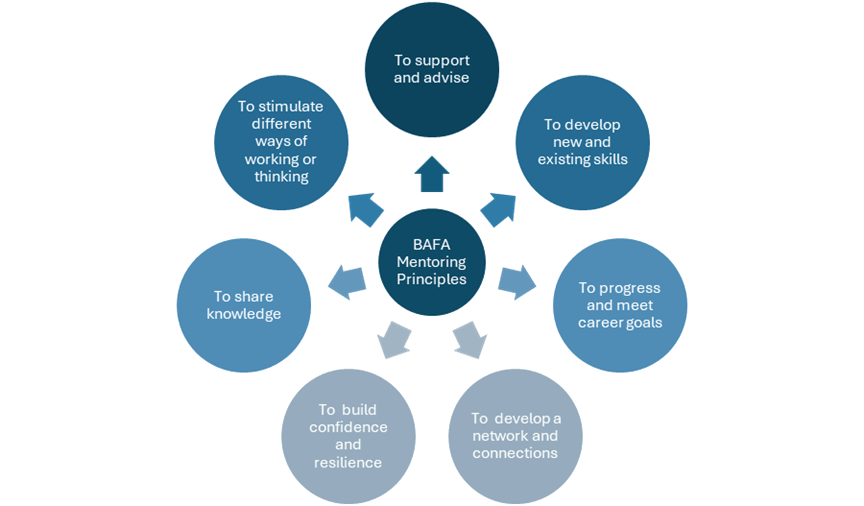
Mentorship Scheme Principles
- To create a supportive and productive mentoring community where ECIs can benefit from expertise and experiences of identified mentors within the BAFA membership.
- While the scheme is primarily aimed at all graduate students, the toolkit and associated activities will be open to all membership regardless of their career stage.
What does our Mentorship Scheme look like?
Mentees & Mentors
There are no assigned mentors and mentees on a formal one-to-one basis. Our aim is to build a community within the BAFA membership, sharing knowledge and advice within a forum context. This will allow mentors and mentees to engage with this as and when they are able to. Specific activities conducted as part of the mentorship scheme will provide mentoring on a ladder model, providing all members the opportunity to feed up or down the ladder on a range of topics to individuals at different career levels.
For activities that require formal (e.g. peer-review) or informal (e.g. cafés, networking opportunities) discussion, the committee will match ECIs (mentees) with a prospective mentors that are in the mid- late- stages of their career. The matching process will be dependent on the desired outcomes of the mentee and mentor participation in the proposed activity. The mentor-mentee relationship in these proposed activities is a one-off experience and neither party are expected nor required to maintain the mentoring relationship on conclusion of the activity.
The mentorship scheme is, therefore, distinct form supervision, counselling or formalised mentoring programmes with one-on-one mentoring.
Mentor and Mentee Principals
- Be honest, open, non-judgmental and respectful
- Actively listen, to build a rapport and provide constructive feedback
- Respect the boundaries of mentor/mentee
Proposed Activities
We have proposed a list of potential activities that we believe would be useful to our membership.
- Workshops based on providing peer-reviews of prospective grant proposals, manuscripts, CV’s and associated documents for job applications.
- Informal ‘café’ meetings to allow for informal discussions about any topics ECIs wished to discuss, for example, problem solving research tasks.
- Building a forum on website or a group through LinkedIn to start building a community that is available throughout academic year. This will allow ECIs to reach out should they require advice or support but were unable to attend any workshops or cafes.
Committee’s Next Steps
The committee is currently undertaking a questionnaire with our membership to find out what stages of careers members are at; prospective mentees and mentors and what kind of mentoring activities/topics are considered most important by ECIs (IN PROGRESS APRIL 2026)
Following the results of the survey, which will be shared with the membership in due course, we will develop a mentoring activity schedule (4 per year, including one at our in-person conference) and development of a toolkit, inclusive of infographics or resource list, to be housed on the BAFA website to be easily accessible.
 British Association for Forensic Anthropology