
Save the date!
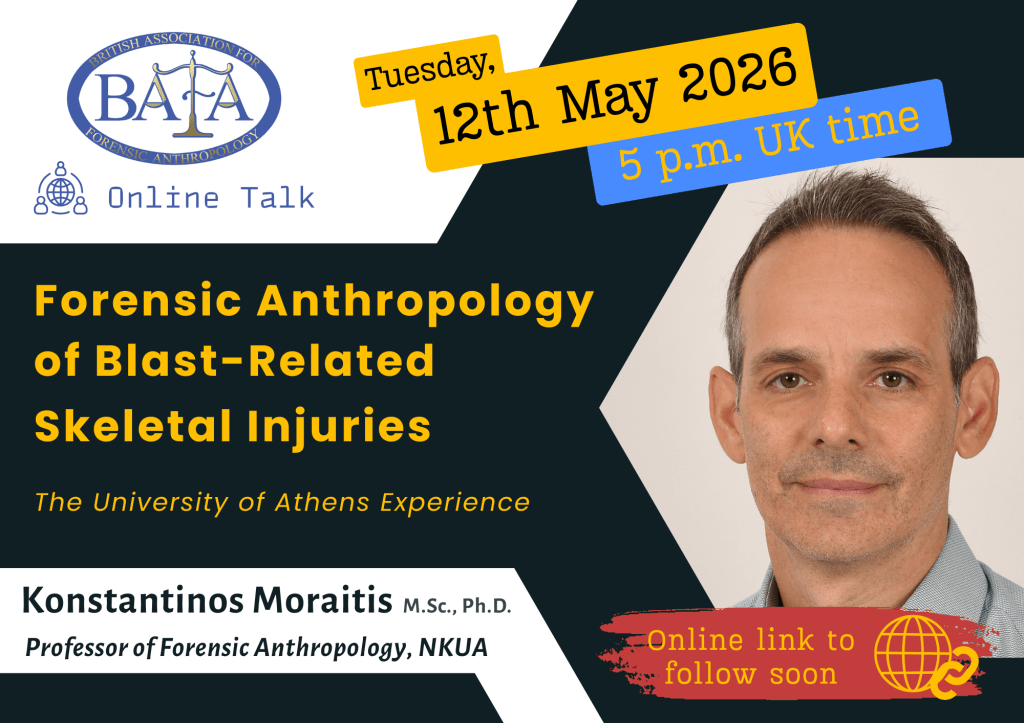
Join us online on Tuesday 12th May 2025 at 5 p.m. UK time.
Register here and we’ll send you the link to the talk: https://forms.gle/Rq7dikn6WBDRrsVf9
BAFA International Outreach Webinar series aims to promote engagement between the BAFA membership and international forensic anthropology practitioners and researchers. Webinars are free to attend and open to BAFA members.
About this talk:
Blast-related skeletal injuries present unique challenges in forensic anthropology, frequently occurring in post-conflict, terrorist, or industrial settings. Forensic anthropologists play a vital role in these investigations by reassociating remains, identifying victims, and evaluating trauma. Unlike gunshot wounds, blast injuries result from supersonic pressure waves and the propulsion of irregular, asymmetrical shrapnel. This presentation shares insights from the National and Kapodistrian University of Athens (NKUA) experience in evaluating skeletal blast trauma. Diagnosis involves macroscopic and X-ray examination to differentiate shrapnel trauma from ballistic injuries. Shrapnel defects are typically highly variable in size, rarely perforate bone, and frequently leave fragments embedded within the remains. By analyzing the wide distribution of these bone defects, practitioners can reconstruct the direction and intensity of the blast. These methods are illustrated through case studies from post-conflict settings, highlighting the necessity of understanding wound morphology and environmental context to accurately diagnose mechanisms of injury. Ultimately, the presentation emphasizes the specialized diagnostic framework required to interpret the “skeletal signature” of explosions in forensic casework.
About the speaker:
Konstantinos Moraitis, M.Sc., Ph.D., is a Professor of Forensic Anthropology and the Founder and Head of the first Forensic Anthropology Unit in Greece, established at the Department of Forensic Medicine and Toxicology, School of Medicine, National and Kapodistrian University of Athens (NKUA). Since 2022, Prof. Moraitis has also served as the Director of the Criminology Museum at the NKUA Medical School. In addition to his academic and research roles, Prof. Moraitis has provided expert forensic casework for Greek courts, the Office of the Prosecutor, and police authorities since 1999. His expertise includes field recovery, biological profiling, positive identification, skeletal trauma analysis, estimating time since death, and aging the living. His international experience includes humanitarian missions in Bosnia, Kosovo, and Cyprus with organizations such as the International Criminal Tribunal for the former Yugoslavia (ICTY) and Physicians for Human Rights (PHR). Since 2019, he has led a collaborative humanitarian project between NKUA and the Republic of Cyprus, conducting forensic examinations of remains from the 1974 Turkish invasion to determine cause and manner of death. A prolific researcher, Prof. Moraitis has authored numerous peer-reviewed articles and book chapters, co-authored a definitive text on wound ballistics in Greek, and presented at various international conferences. He is a member of the American Academy of Forensic Sciences.


Leave a Reply