
Join us at the two-day event at Durham University, an opportunity to network, develop your CPD and receive an annual update on good practice and new research.
We welcome all interested in the latest developments, in particular practitioners, academics, researchers, technicians and students.
Looking Back, Looking Forward: Innovation and Development in Forensic Anthropology
This year’s British Association for Forensic Anthropology (BAFA) Conference focuses on innovation and the future development of the discipline, exploring how emerging technologies, analytical approaches and interdisciplinary collaboration are shaping forensic anthropological practice. The theme, Looking Back, Looking Forward: Innovation and Development in Forensic Anthropology, highlights the importance of building on established knowledge while embracing new methodologies that advance research, education, and casework. The conference will also highlight ontogenetic development within forensic anthropology, fostering discussion on human growth and development, age estimation, and the application of innovative approaches to understanding age-related variation in the human skeleton. By bringing together perspectives from research, education and professional practice, the conference aims to foster dialogue that supports both theoretical advancement and applied forensic anthropology.
Present your work or research
Please note that abstract submissions are now closed.
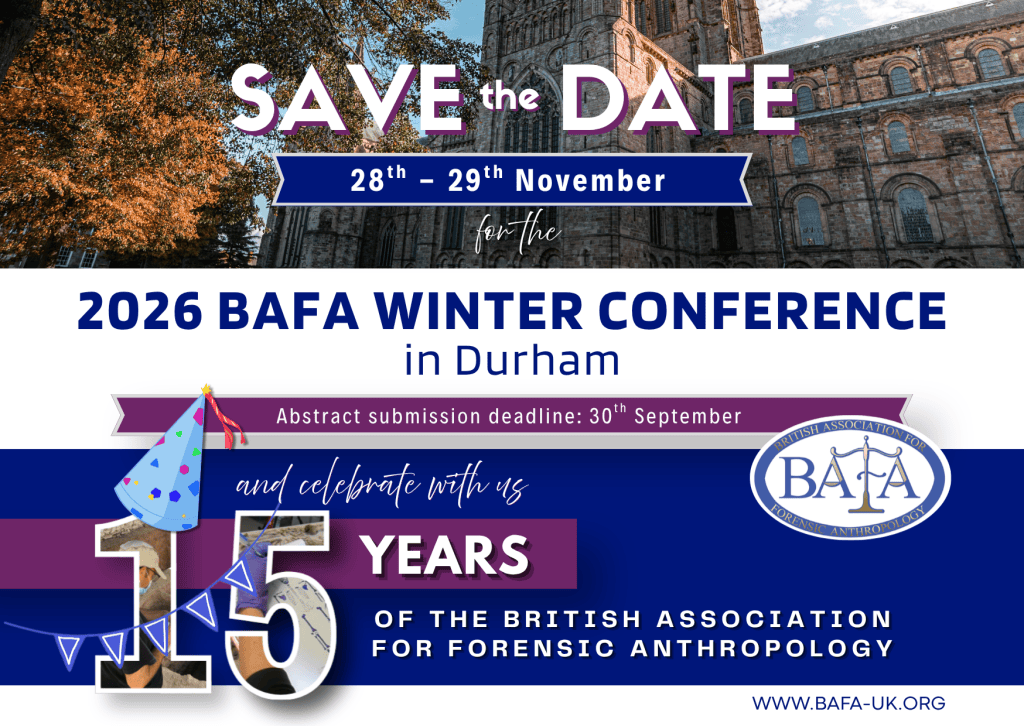
Abstract submission deadline is 30th September 2026. To present a poster or a podium presentation, please complete the form below:
Registration
To participate, please register here:
Deadline for registration: Friday 20th November 2026, 5pm.
Fees
- Members: £60
- Members, reduced price (students, unemployed and retired): £50
- Non-members: £80
You will receive a PayPal invoice by email.
The price for the workshop for non-members is £20, which will be added to the invoice.
JOIN BAFA: Become a member
Programme Highlights
Saturday, 28 November 2026
- Registration opens at 9:00 a.m.
- Keynote lecture from Luis Fondebrider, Forensic Anthropologist
- Poster and podium presentations
- BAFA AGM (Members)
- Screening of El Equipo directed by Bernardo Ruiz followed by a Q&A with Luis Fondebrider.
- Evening social event (Details to follow)
Sunday, 29 November 2026, 9.00-1.00pm
- CPD workshop (Details to follow)
- Keynote lecture, ‘A journey through time & ageing in human bone: the biomechanics view’, from Dr Peter Zioupos Vice-President of the Chartered Society of Forensic Sciences and Professor Emeritus of the University of Hull.
- Keynote lecture from Professor Trudi Buck, biological anthropologist and Professor in the Department of Anthropology, Durham University.
Conference Programme
The full conference programme will be published here in due course.
Keynote Speakers
Dr. Luis Fondebrider
Dr. Luis Fondebrider is an Argentine forensic anthropologist internationally recognized for his work on human rights violations and the identification of the disappeared. He founded the Argentine Forensic Anthropology Team (EAAF) in 1984, serving as its president until 2021, and was Director of the ICRC Forensic Unit from 2021 to 2022. With over 40 years of experience, he has contributed to more than 1,500 cases around the world, advising courts, UN bodies, governments, and NGOs. His work spans forensic investigations in contexts of political, ethnic, migratory, and armed violence, and includes shaping international policies on human rights and the search for the missing. The EAAF has led forensic investigations in over 65 countries and was nominated for the Nobel Peace Prize in 2020.
Dr Peter Zioupos
Dr Peter Zioupos is currently the Vice-President of the Chartered Society of Forensic Sciences, a Professor Emeritus of the University of Hull, Visiting Professor in the ‘Research Centre for Future Transport and Cities’ of Coventry University, Visiting Fellow of the Cranfield Forensic Institute and Fellow of the Institute of Physics and Engineering in Medicine. Knowing more about bone and tissues is a lifelong ambition for Prof P Zioupos. His skills and expertise are mostly on tissue mechanics and the biomechanics of materials. This stretches his engagement across the scientific disciplines of: Medical Physics; Materials Science; Biophysics; Biomedical Engineering and Biomechanics.
Musculoskeletal & Medicolegal Research of this kind can be applied then to issues such as musculoskeletal performance; skeletal conditions; genetics and disease; human factors; victim identification; trauma analysis; identification of trauma cases; and environmental effects on tissues.
His most recent research work was in detecting the arrival of ‘maturity’ in the human skeleton by biomechanical and physicochemical methods and on the influence of varying strain rate on the properties of bone. The latter was followed by a paradigm shifting paper which has shown that the fragility of ageing bone is a result of a ductile-to-brittle-transition (DBT) which shifts to lower strain rates for older individuals. The cause of this effect is biophysical in its nature and shows that bone fracture is a ‘dynamic’ event and that the bone material experiences failure in a ‘stochastic’ manner. In this view and in forensic cases then, the so called ‘bone properties’ can only be understood in ‘context’ and within the environment of the scene of the incident.
Professor Trudi Buck
Trudi Buck is a biological anthropologist whose work connects research into past lives with creative, inclusive approaches to university education. Based in Durham University’s Department of Anthropology, she investigates what human remains can reveal about identity, migration, inequality and responses to death, while asking how such remains should be studied and taught ethically.
A central theme of Trudi’s work is osteobiography: the integration of skeletal, archaeological and contextual evidence to reconstruct the experiences of particular individuals. Her research on unusual Roman-period burials along Hadrian’s Wall includes investigations at Vindolanda, Magna and Brocolitia. These cases illuminate people who are largely invisible in written accounts, including children, migrants and enslaved individuals. Her approach gives prominence to their individuality while acknowledging the uncertainty inherent in archaeological interpretation.
Trudi’s teaching likewise challenges established disciplinary practices. She encourages frank discussion of how anatomical knowledge and teaching collections were historically produced. She promotes transparency, dignity and approaches that recognise the deceased as individuals.
She is also developing accessible forms of experiential learning. Her forensic anthropology teaching uses mock crime scenes to help students apply practical skills, while her virtual-reality projects translate laboratory and problem-based activities into flexible environments without the time and participation barriers of conventional practical classes.
Documentary Screening: El Equipo
As part of the BAFA Conference 2026, delegates are invited to a special screening of El Equipo, the acclaimed documentary by Bernardo Ruiz that chronicles the pioneering work of the Argentine Forensic Anthropology Team (EAAF) in investigating human rights violations and identifying the disappeared. Through decades of forensic investigation, the EAAF has helped uncover the truth, provide answers to families, and support justice efforts around the world.
Following the screening, delegates will have the opportunity to participate in a Q&A with Dr Luis Fondebrider, founder of the EAAF and internationally recognised forensic anthropologist.
For more information on the documentary please visit: El Equipo | Quiet Pictures
Venue & Travel Information
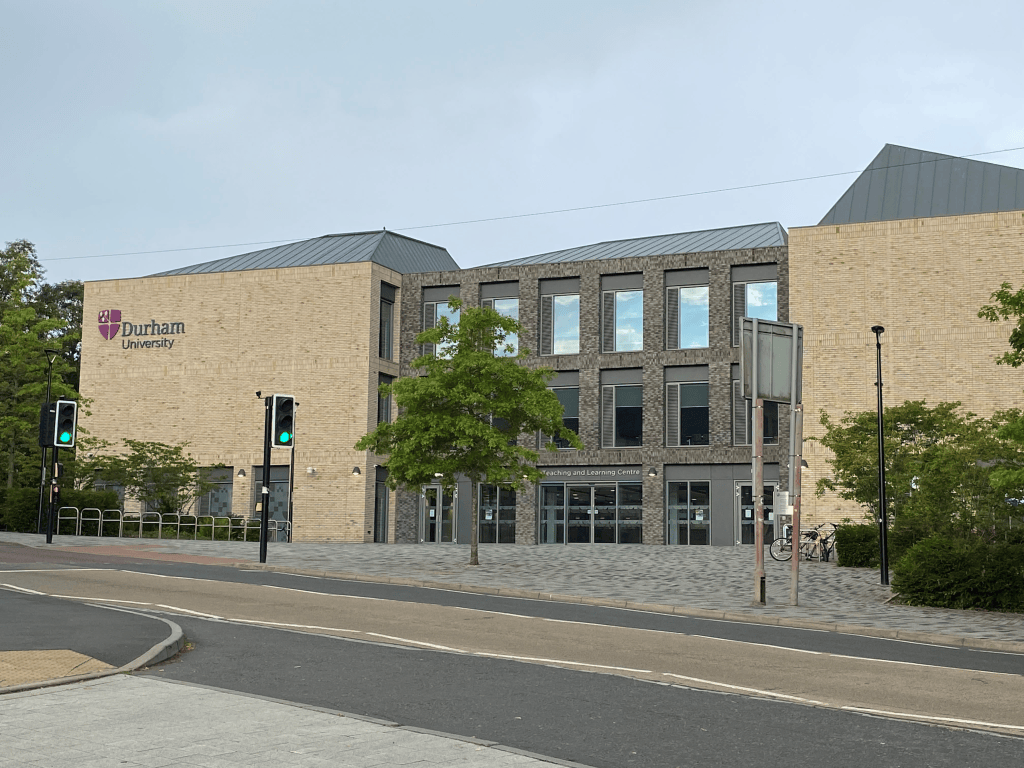
The conference will be held in the Teaching and Learning Centre, Durham University
Address: South Road, Durham, DH1 3LS
Getting There
The Teaching and Learning Centre is located on Lower Mountjoy and is approximately:
- 30 minutes walk from Durham Railway Station
- 20 minutes by public transport
- 5 minutes by taxi from the railway station
Public Transport
From Durham Bus Station (around a 5-minute walk from the railway station), regular bus services run to the university campus. We recommend the Arriva X12, 6 or 56 services and alighting at New Inn, Church Street. The Teaching and Learning Centre is then a 4-minute walk away.
Taxis, including Uber and local firms, are readily available throughout Durham city centre.
For more information on travelling to and around Durham, visit: This is Durham – Visitor Information
Catering
We’re pleased to provide lunch on Saturday, along with refreshments during breaks and poster sessions throughout the conference. To help us cater for everyone, please let us know about any dietary requirements when you register.
Follow us on social media
Further details on keynote speakers and annual CPD event will be coming soon!


Leave a Reply